Features
Jails, done the ZFS way
Everything below is described in the project's design document. Each area carries a status tag; the status page says exactly what is implemented, what has run on FreeBSD 15.1 and what is still planned.
Projects and trust
Who may do what, and where.
- A project is a logical namespace. Networks and storage are separate, host-managed resources that a project is granted, optionally as a sub-range with a quota. A project also sets quotas for jails, CPU, memory, PIDs and addresses.
- Identities are pinned client certificates, API tokens and users of the web console. Each has a role (
readonly,operatororadmin) and a project scope. An empty project list never means access to everything; global access is an explicit flag that only a global admin can grant. - Trust is built without trust-on-first-use: an admin creates a single-use trust token bound to a name, with an expiry, and the new client pins the server fingerprint from it.
- Every route has a permission entry, or the daemon refuses to start. State changes are audited. Dangerous parameters (raw jail parameters, host mounts, raw PF) need the
adminrole. - A separate dataset is not a full security boundary. Jails share the host kernel, so a high-security tenant needs a dedicated pool, a dedicated host, or both.
# on the server
$ jailops trust add --name laptop --role operator --projects web

# on the client, with the token it printed
$ jailops remote add host.example --token <token>
$ jailops project switch web
$ jailops whoami
ZFS clones, image generations and storage
ZFS is the storage layer. There is no other backend and no nullfs thin layout.
- An image is a line of immutable generations built from pkgbase. Each generation is a dataset with a read-only snapshot that never changes.
- A thin jail is a ZFS clone of one generation. What must survive an update (
/etc,/usr/local, selected/varpaths,/home,/root, volumes) lives in separate datasets mounted under the root. A thick layout, a full independent copy, is also available. - Upgrade takes one atomic snapshot of the jail, clones the new generation, merges
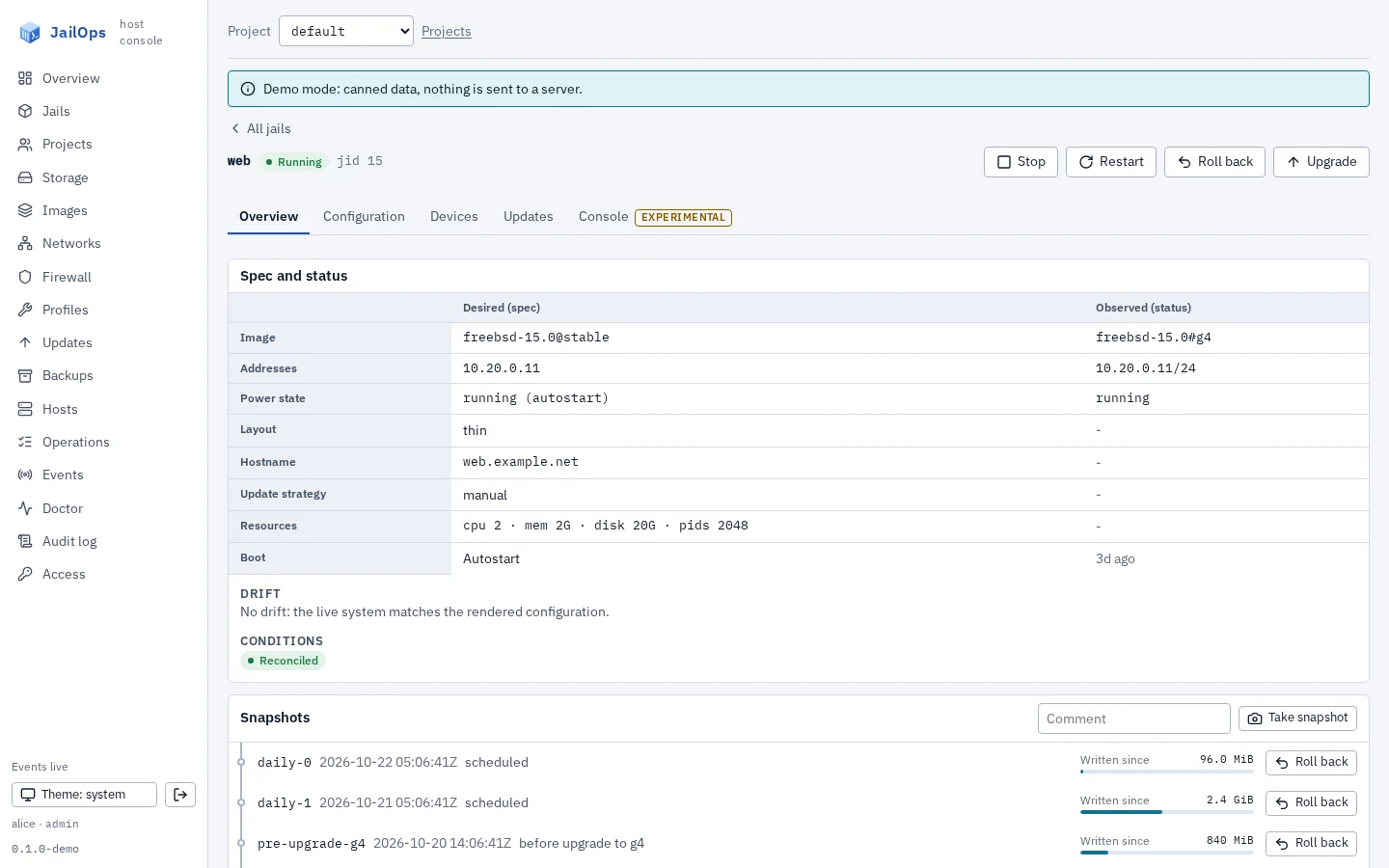
/etcthree ways, swaps the roots withzfs rename, health-checks, and swaps back on failure. An unmergeable conflict leaves the jail on the old generation. - Rollback has scopes.
rootswaps the OS back and keeps your data.dataandalldiscard what was written since, show how many bytes are at stake, and need the jail name typed to confirm. - Storage is a named ZFS location on a host, with quotas per project and per jail. Each pool that holds thin jails keeps its own copy of the generations it uses.
$ jailops storage create fast --dataset tank/jailops
$ jailops image build freebsd-15
$ jailops jail upgrade web --dry-run
$ jailops jail upgrade web
$ jailops jail rollback web --data --snapshot before-upgrade
# shows the bytes that would be discarded, asks for the jail name
On FreeBSD 15.1 a prototype built a pkgbase userland into an empty dataset, started and health-checked a thin jail cloned from it, upgraded it with etcupdate, swapped roots, and showed that a root rollback keeps data written after the upgrade. One question, how /var/db/pkg behaves after a root swap, is still open.
VNET and PF networking
One way to do networking, with the addresses written down.
- Every jail uses VNET and an epair on a bridge that JailOps created. Shared-IP and host-networked jails are not supported. JailOps never modifies a bridge it did not create.
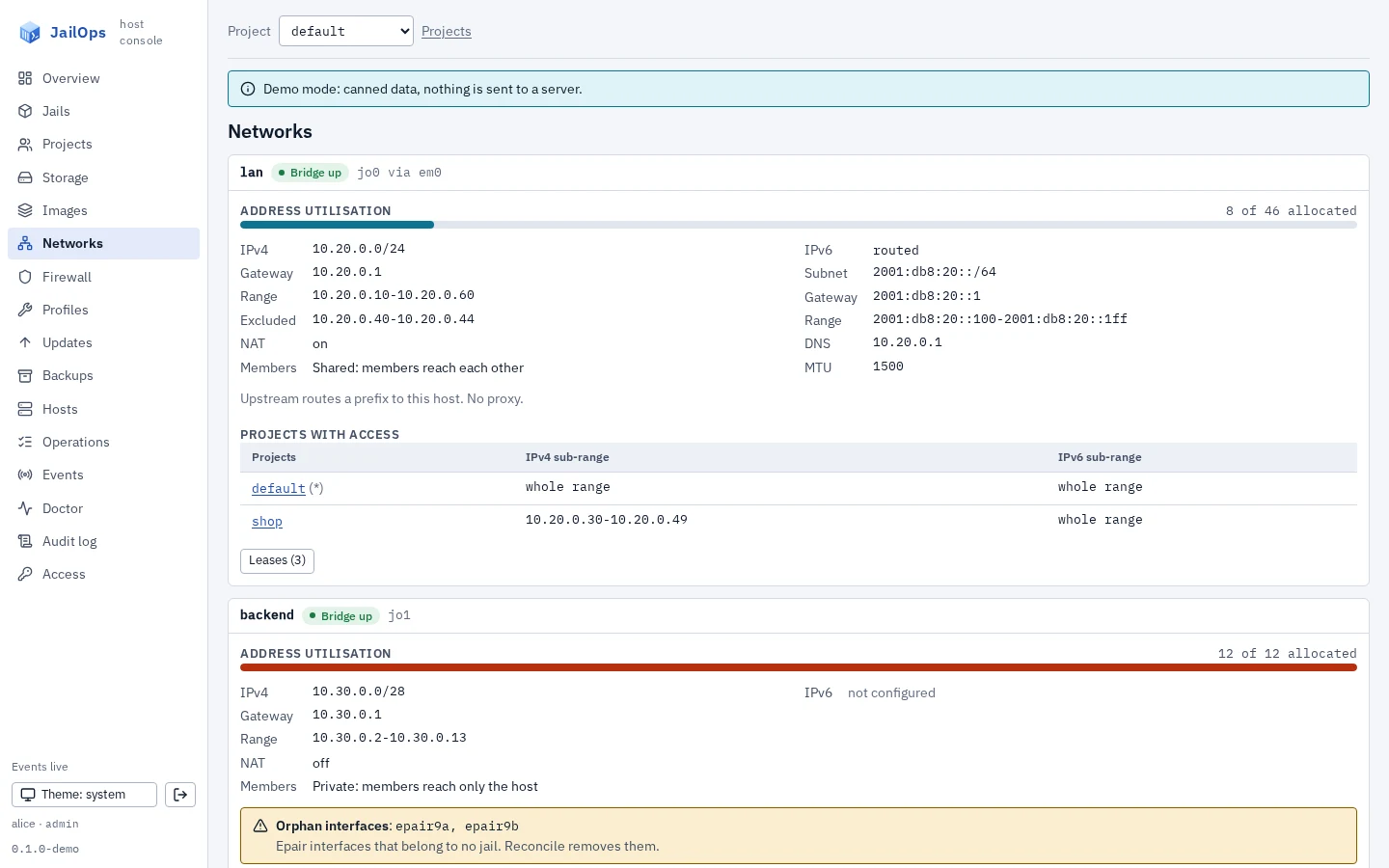
- A network has a subnet, a gateway that is a real address on the bridge, and an explicit allocation range. JailOps allocates from the range and writes the address into the jail spec.
- No DHCP, no router advertisements, no SLAAC.
accept_rtadvis disabled in the jail. Ordinary IPv6 neighbor discovery still works because it is part of IPv6, not a service. - IPv6
routedmode, where the upstream routes a prefix to the host, must work fully without any proxy. A routed prefix can be carved into/80networks, and unallocated space gets a reject route so packets do not loop. - The built-in IPv6 NDP proxy for switched /64 networks is experimental, off by default, and not yet proven on FreeBSD.
- PF only, one anchor per jail. A ruleset is rendered, checked with
pfctl -n, loaded in one operation and read back. JailOps never ownspf.conf; you add three anchor lines once.
$ jailops network create dmz --subnet 192.0.2.0/24 \
    --gateway 192.0.2.1 --range 192.0.2.10-192.0.2.40
$ jailops network leases dmz
$ jailops firewall address-set create office \
    --address 192.0.2.0/24 --address 198.51.100.7
$ jailops firewall policy create web --default-in deny \
    --default-out allow --rule allow in tcp port 80,443
On FreeBSD 15.1, anchors load, replace and flush without touching the administrator's ruleset, and a reload is atomic. On the arm64 test host, PF between projects on a shared bridge and per-jail source-address enforcement worked, with nested anchors needing anchor "*" in every parent. Ethernet-level protection (ARP, NDP, MAC spoofing) is not covered and remains open.
Encrypted, deduplicated chunk backups
A repository server that cannot read what it stores.
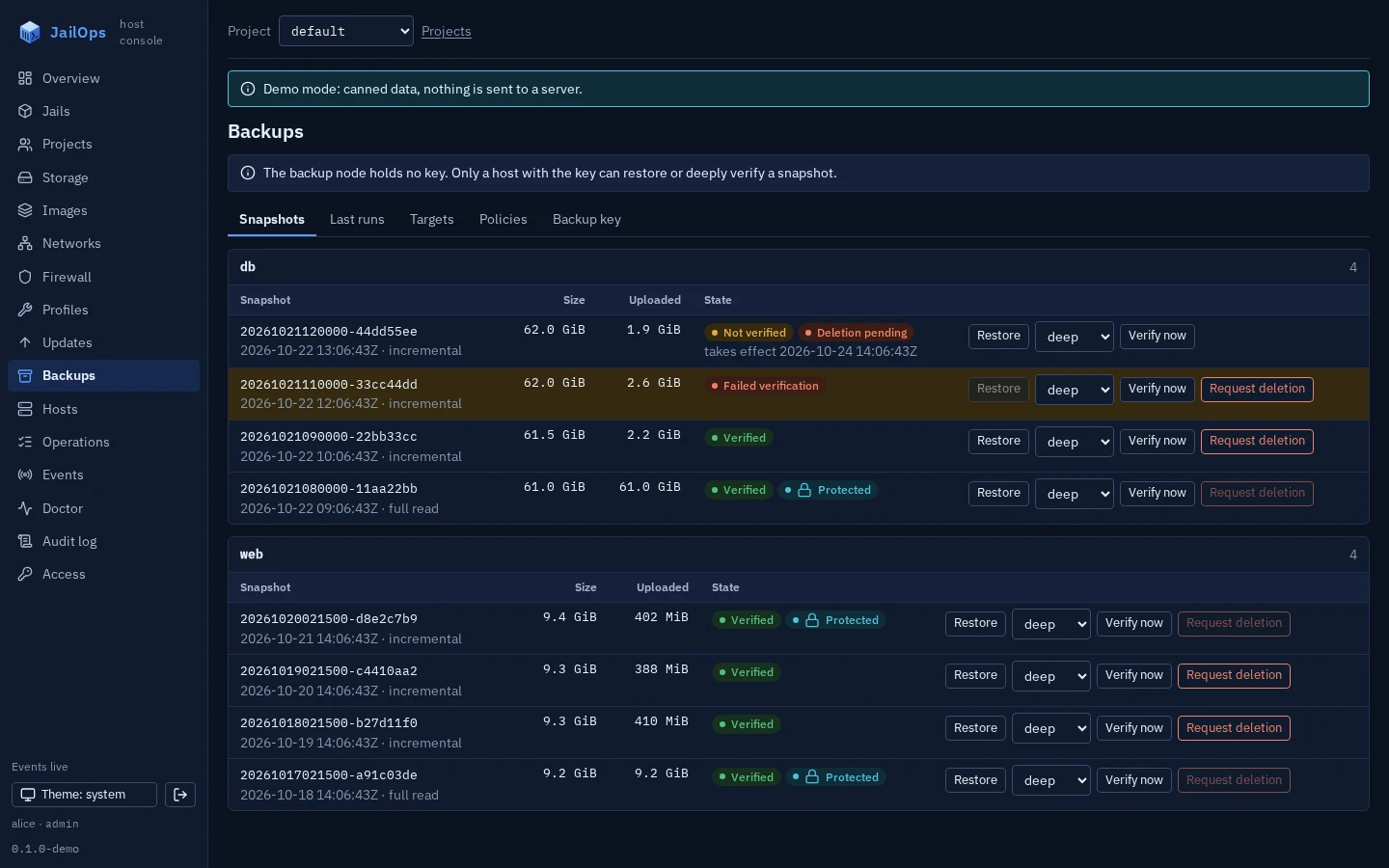
- The host does the cryptography. It cuts data into content-defined chunks, compresses them with zstd, and encrypts them with XChaCha20-Poly1305. The chunk id is a keyed HMAC, so the server cannot even confirm that it holds known data.
- The backup node,
jailops-backupd, is keyless. It stores chunks on a directory or an S3 bucket, verifies them by trailer without any key, and runs retention, garbage collection and quarantine. It links no jail, ZFS or decryption code, and a test enforces that. - Every snapshot is self-contained: a list of references to chunks. There are no incremental chains to break, and only new chunks are uploaded.
- The key is a file on the host. A recovery key is shown once, and the master key can be wrapped to offline recovery recipients, so a restore on a new host needs only a recovery key.
- The server sees object counts and sizes, the deduplication graph, snapshot times, and host and jail identity. It never sees file names, contents or keys.
- This is not ZFS send and not ZFS native encryption. ZFS snapshots only give the backup a consistent view. Replication between trusted hosts is a separate feature, below.
$ jailops backup target create nightly --kind node \
    --address https://b.example:8443 --fingerprint <sha256>
$ jailops backup policy create nightly --selector env=prod \
    --target nightly --schedule "0 2 * * *" --keep-daily 14 --keep-weekly 8
$ jailops backup list
$ jailops backup verify <backup>
The daemon is not root: file agents of the privileged helper, confined by chroot to one checked directory, read the snapshot and write the restored jail. On the arm64 test host a jail was backed up to a node, verified at three depths and restored as a new jail. Snapshot metadata matched live stat, and inode and ctime were stable across snapshots; zfs diff misses hard-link name changes, so capture rescans those.
Replication between trusted hosts
For migration and warm standby. Not a backup.
- ZFS send and receive between hosts that trust each other, built on incremental chains with guid continuity, bookmarks, holds and resume tokens, and never
recv -Fover existing snapshots. - On FreeBSD 15.1 a prototype confirmed the ZFS behaviours this relies on, and found that an incremental on top of a receiver with a newer snapshot is accepted without
-F. JailOps therefore enforces guid continuity itself instead of trustingrecvto refuse. - A compromised source can corrupt a replica, which is exactly why backup is a separate, keyless, append-only repository. The replication code exists as a library and is not yet exposed through the API or CLI.
Declarative fleet management
jailops-sync and the optional hub.
- A fleet is a git repository of YAML: hosts, host groups, jail templates, networks, policies and rollouts. Secrets are encrypted with age.
jailops-syncplans before it applies. It writes only objects it owns (markedmanaged_by: sync:<fleet-id>), never changes or deletes anything else, and deleting even its own objects needs an explicit--prune. Every apply writes a JSONL log.- Hand edits to an object that sync owns are reported as drift and reverted on apply.
adoptwrites live objects into the repository as YAML, andprune-checklists what is live but undeclared, without deleting. - Rollouts run staged upgrades with a canary, a batch size, a pause and a health gate.
- A hub is a mode of
jailopsd. It keeps a registry of hosts, authenticates the caller and forwards requests over pinned mTLS (jailops --host host-b jail list). If the hub is down, hosts keep working. There is no shared storage and no live migration. - It is built only on the SDK, and a test enforces that it imports nothing from the daemon. There is no scheduler: a jail is declared on a named host.
$ jailops-sync validate
$ jailops-sync plan
$ jailops-sync drift
$ jailops-sync sync --apply
$ jailops-sync rollout list

# rollouts/web-upgrade.yaml
apiVersion: jailops/v1
kind: Rollout
metadata:
  name: web-upgrade
spec:
  selector: {tier: web}
  canary: 1
  batch_size: 2
  pause: 30s
  health_gate: {timeout: 2m, interval: 5s}
REST API, Go SDK and web consoles
One API for people, scripts and the fleet tool.
- REST under
/1.0. Mutations may be synchronous or asynchronous, with an operations resource you can wait on. Updates useETagandIf-Match, events stream as server-sent events, features are negotiated byapi_extensions, and error codes are stable. - Authentication: a unix socket with peer credentials, mutual TLS with pinned fingerprints, API tokens, and web sessions with CSRF protection.
- Go SDK: a separate module with no third-party dependencies,
contexteverywhere, typed wire types,Waitfor operations, iterators for lists and event streams, and an in-memory fake server for tests. The CLI andjailops-syncuse nothing else. - CLI:
jailopsprints tables for people and-o json,yamlornamefor scripts, has stable exit codes, a--dry-runflag, andjailops explain CODEfor every error code. - Web consoles: a host console (also the hub console) embedded in
jailopsd, and a backup console embedded injailops-backupd. They are Vue 3 apps with a light and a dark theme, and each may only call its own API prefixes.
$ jailops jail list -o json
$ jailops jail list --state running -o name
$ jailops events --type lifecycle -o json
$ jailops explain not_found
More, and what is not here
- Linux jails (Alpine and Debian) through the Linuxulator. Experimental. Alpine and Debian 13 (glibc) ran as jails on FreeBSD 15.1 arm64 with IPv4 and IPv6; amd64 and other glibc distributions are not yet verified.
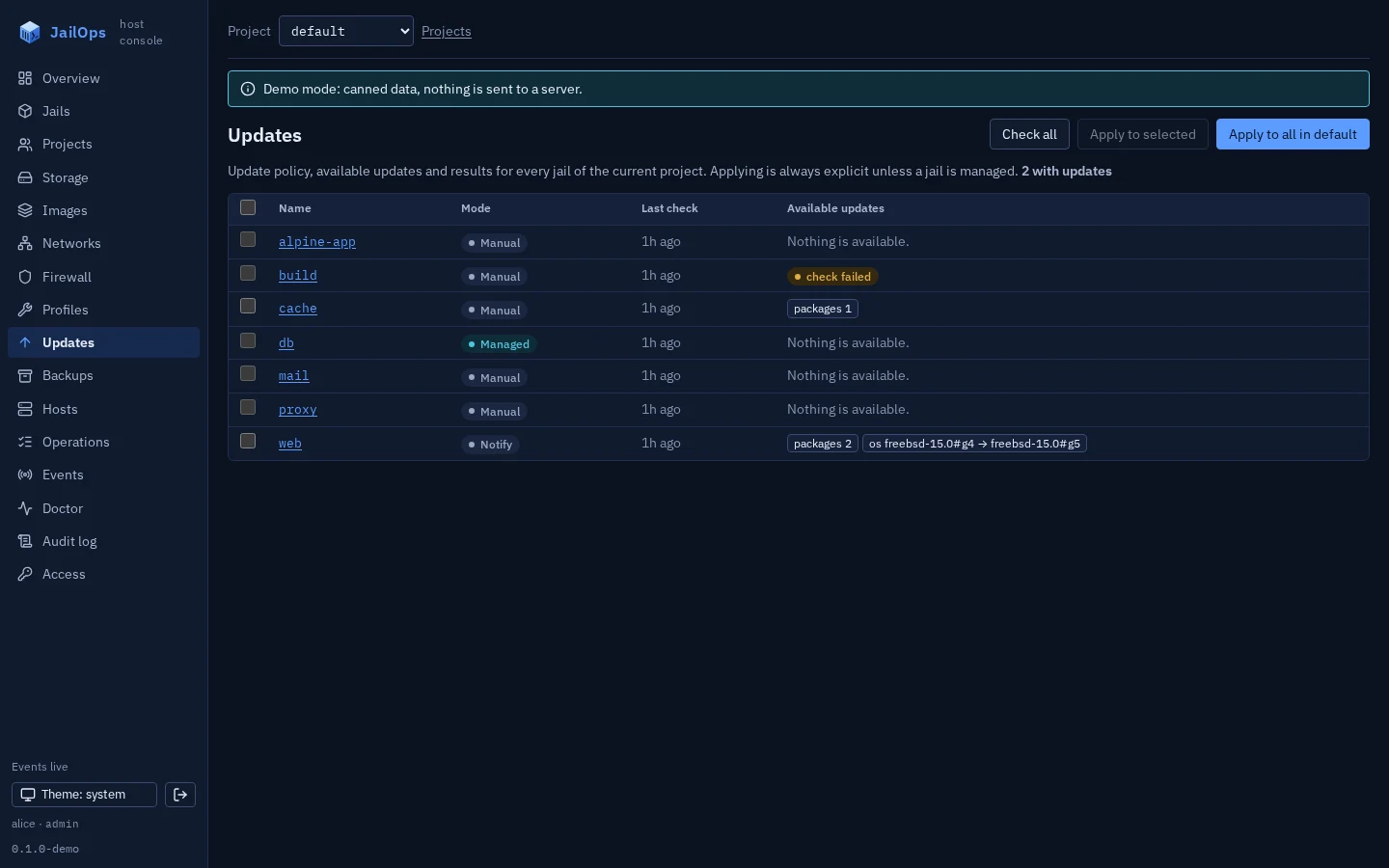
- Provisioning and managed updates. Today you upgrade a jail on demand with
jailops jail upgrade, andjailops-syncrollouts stage upgrades across hosts. Update policies with schedules and notifications are Planned. - Cluster mode with Raft and self-healing fleets are Planned. Failover of stateful workloads will not happen automatically without fencing.
- Out of scope by design: virtual machines, bhyve, OCI containers, live migration, and any storage other than ZFS.